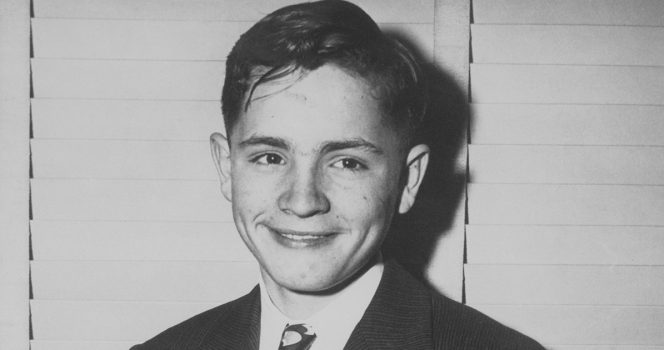
Even the most harmless-looking child can grow into something unrecognizable when early life is shaped by chaos, violence, and abandonment.
And that was undeniably the case with the man we’re about to talk about today.
It’s almost unimaginable that the innocent-looking boy in this photo would one day become one of the most notorious criminals in history.
Born to a 16-year-old mother on November 12, 1934, in Cincinnati, Ohio, the boy’s early life was anything but stable. His father was a con artist who vanished before he was born.
By age four, after his mother was arrested for assault and robbery, he was sent to live with his aunt and uncle in McMechen, West Virginia.
His mother, Kathleen, had committed the crime alongside her brother, Luther, who smashed a bottle over a man’s head before stealing his car. Luther received ten years in prison, while Kathleen was sentenced to five — but only served three.
Visits with his mother were mandatory, though the boy often protested.
Kathleen eventually returned home, and the first weeks after her release from prison were described as the happiest time in his life. But then, she descended into alcoholism.
Days at a time, she would disappear, leaving the boy in the care of a rotating cast of babysitters. Eventually, she decided to send him to reform school — but that too would fail to contain his behavior. By age nine, he would later claim, he had already set one of his schools on fire. Often, he also got in trouble for truancy and petty theft.
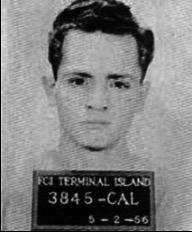
At thirteen, he was placed in the Gibault School for Boys in Terre Haute, Indiana, a Catholic institution run by strict priests who administered beatings for even minor infractions. He soon fled — first back to his mother, who sent him straight back, and then to Indianapolis, where he began committing burglaries to survive. He slept in the woods, under bridges and wherever else he could find shelter.
Arrests and stints at juvenile institutions followed, including a school in Omaha, Nebraska, where within just four days, he and a classmate stole a car and committed armed robberies en route to a relative’s home — an apprenticeship with a professional thief. He even devised a bizarre self-defense tactic he later referred to as the ‘insane game’, shrieking, contorting his face, and flailing his arms wildly to convince stronger attackers that he was unhinged.
For a brief period, he tried to go straight, working as a Western Union messenger.
But it didn’t last — he quickly slipped back into his old patterns. And the boy’s criminal behavior escalated rapidly. Psychiatric evaluations would later describe him as “aggressively anti-social.”
At one point, he was arrested for sexually assaulting another boy at knifepoint while serving time at a federal reformatory. He repeatedly engaged in sexual acts with other inmates, leading to transfers to maximum-security facilities. By the time he turned twenty-one, his release would mark the beginning of a pattern of manipulation, theft, and violence that would define his life.
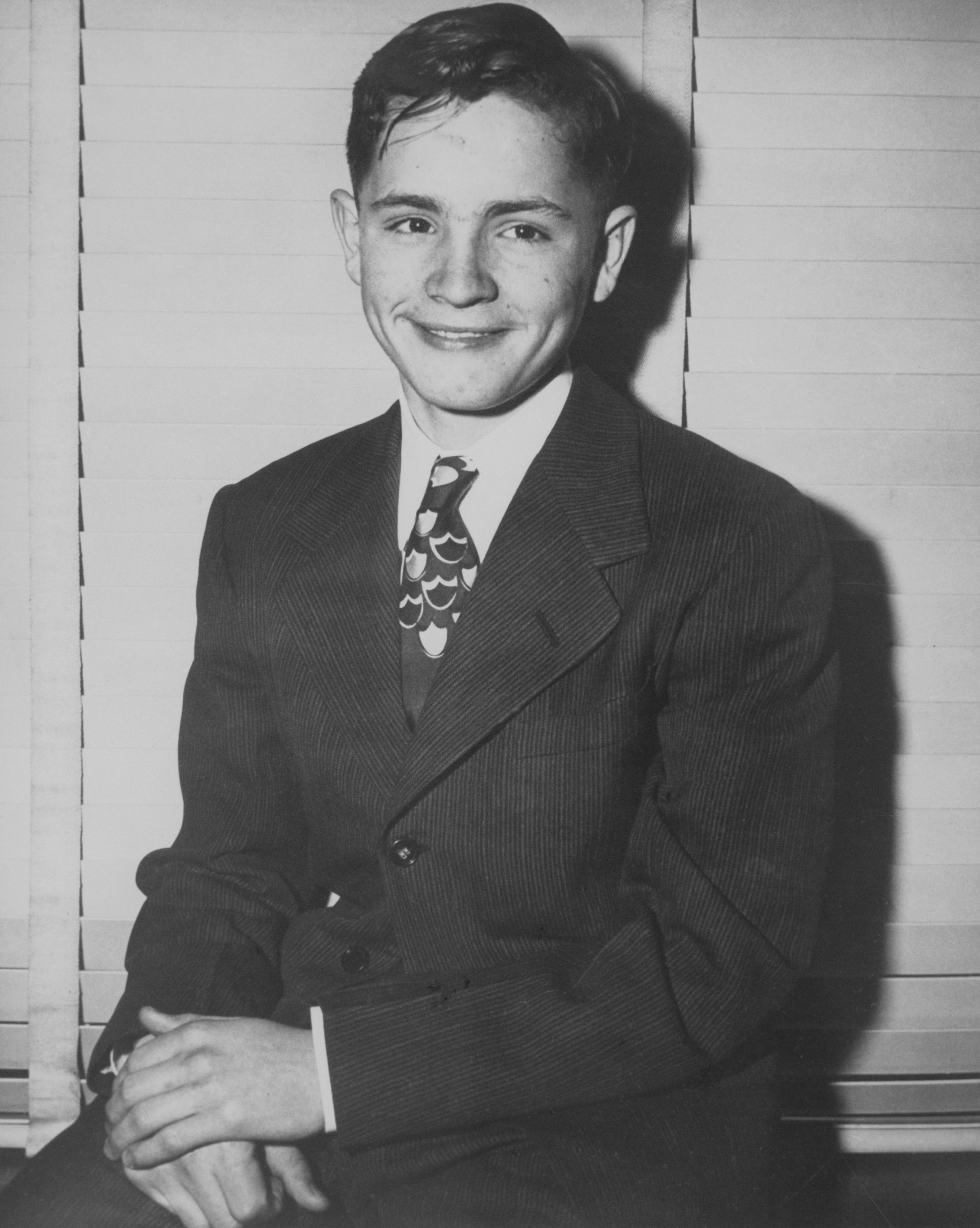
Even in adulthood, he showed an unsettling ability to draw people under his influence. He married, moved across states in stolen cars, and flirted with criminal enterprises. His ambition for control extended to women, including attempts to establish prostitution rings and relationships with underage girls — crimes for which he was repeatedly imprisoned.
During one sentence at McNeil Island penitentiary in Washington, he experimented with hypnosis, practicing on fellow inmates, including actor Danny Trejo. These skills would later become tools in a far more sinister enterprise.
By the late 1960s, his mental state had fractured completely. He convinced a group of vulnerable followers that he was a prophetic figure. The Beatles, he claimed, were speaking directly to him through their songs. From this delusion sprang the infamous “Helter Skelter” plan: a race war in which he and his followers would survive in a secret desert bunker and then dominate the world’s Black population, whom he believed would be incapable of surviving independently.
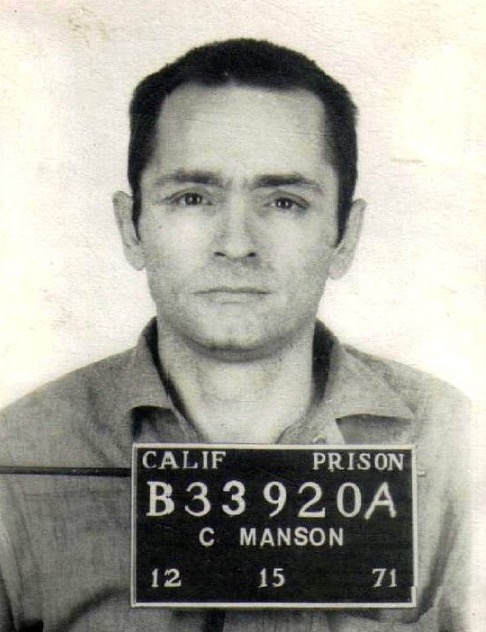
Before this descent into murder, he had once sought fame in music, attempting to break into the West Coast rock scene. He even befriended Dennis Wilson of The Beach Boys, but fame and fortune eluded him. Feeling rejected and humiliated, his obsession turned to revenge — and ultimately, to violence.
In August 1969, he and his cult carried out the brutal murders of actress Sharon Tate, her unborn child, and four others. Orders were given to “totally destroy everyone” in the house and make the killings “as gruesome as you can,” according to follower Tex Watson. The next night, two more victims, Leno and Rosemary LaBianca, were murdered.
The embodiment of evil
Charles Manson — the boy in the photo — had become the embodiment of evil.
“The very name Manson has become a metaphor for evil—and evil has its allure,” prosecutor Vincent Bugliosi would later declare.
Convicted of multiple murders, including those of Tate, LaBianca, musician Gary Hinman, and Donald Shea, Manson was sentenced to death in 1971. Prosecutors argued that although Manson never explicitly gave the order to kill, his beliefs and teachings amounted to a clear act of conspiracy.
His sentence was later commuted to life imprisonment after California abolished the death penalty.
Despite applying for parole twelve times, he remained incarcerated until his death in 2017 at 83, following cardiac arrest complicated by colon cancer.
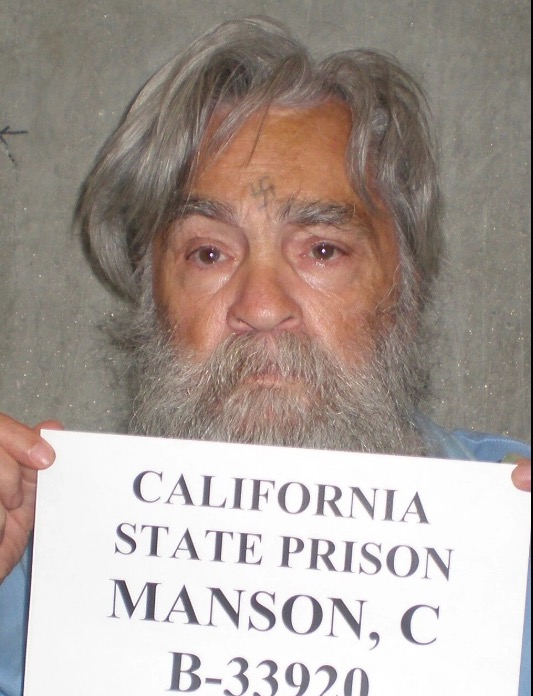
Even in death, Manson’s influence lingered over pop culture. Musicians adopted names inspired by him, and countless books, documentaries, and interviews perpetuated his horrifying legacy.
The boy who once looked harmless in a photograph had transformed into a figure whose name would forever be synonymous with manipulation, murder, and madness.